

How Much Do Travel Nurses Make in 2026? Salary, Weekly Pay, and Real Take-Home Earnings
Travel nursing still carries a reputation for enormous paychecks, housing stipends and contracts that can transform one working year into a financial springboard. That reputation is partly deserved, but the numbers need unpacking.
As of July 2026, advertised travel registered nurse assignments average roughly $2,178 per week nationwide, based on more than 200,000 active jobs tracked by Vivian Health. At that rate, a nurse completing a standard 13-week contract would receive a gross compensation package of about $28,314. A nurse who remained on assignment for 48 weeks could gross approximately $104,544, while working continuously for all 52 weeks would annualize to about $113,256.
Those figures are not necessarily the nurse’s taxable salary. Travel nurse contracts often combine taxable hourly wages with housing, meals and incidental stipends. Some nurses qualify to receive eligible stipends without federal income tax, while others do not because they lack a qualifying tax home or their assignment is considered indefinite.
Location also changes the picture dramatically. Current postings average around $2,590 per week in California, compared with approximately $1,844 in Texas. A specialized assignment, urgent staffing shortage or difficult shift can pay considerably more, while contracts in lower-cost regions may fall below the national average.
This guide explains how much travel nurses make, how pay packages work, which specialties tend to command higher rates and how to calculate what a contract is actually worth after housing, taxes, insurance and unpaid time between assignments.
Recommended Travel Items for Your Trip
TRAVEL NURSE PAY AT A GLANCE
Current average advertised pay: About $2,178 per week
Approximate 13-week gross package: $28,314
Approximate 48-week gross package: $104,544
Approximate 52-week annualized package: $113,256
Average California travel nurse pay: About $2,590 weekly
Average Texas travel nurse pay: About $1,844 weekly
Typical contract length: Often 13 weeks
Biggest pay factors: Location, specialty, shift, urgency and experience
Most important tax issue: Maintaining a legitimate tax home
Average Travel Nurse Salary in 2026

There is no single official “travel nurse salary” because travelers work temporary contracts with different weekly packages, schedules and unpaid gaps.
The clearest current benchmark is the average weekly compensation advertised across active travel nursing jobs. Vivian Health reported an average of approximately $2,178 per week in July 2026. This figure changes frequently as assignments open, fill or adjust their rates.
| Work Pattern | Approximate Gross Compensation |
| One 13-week assignment | $28,314 |
| Two 13-week assignments | $56,628 |
| Three 13-week assignments | $84,942 |
| 48 working weeks | $104,544 |
| 52 working weeks | $113,256 |
These calculations assume consistent weekly compensation of $2,178. Real annual earnings may be lower because of:
- Time between contracts
- Contract cancellations
- Unpaid orientation
- Illness or personal leave
- Reduced guaranteed hours
- Housing expenses
- Licensing and relocation costs
- Insurance premiums
- Tax consequences
A travel nurse who deliberately takes eight weeks off may enjoy more freedom but earn less annually than a staff nurse who works continuously. Conversely, a traveler who stacks strong assignments, works overtime and controls housing costs may significantly outperform the national average.
Travel Nurse Pay Compared With Staff Nurse Pay
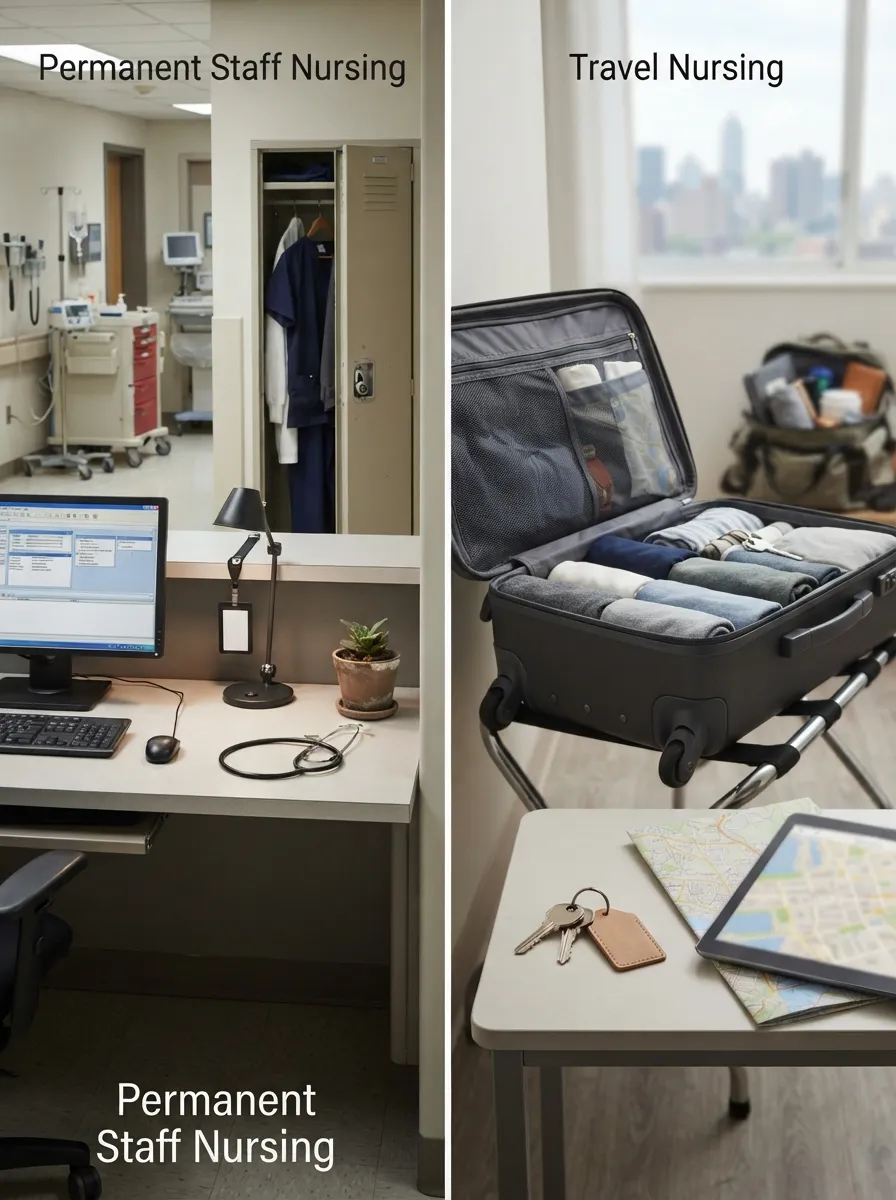
Registered nurses as a whole earned an annual mean wage of $101,420 in May 2025, according to the latest national Occupational Employment and Wage Statistics released by the U.S. Bureau of Labor Statistics. California had the highest state-level mean RN wage at approximately $150,280, while Alabama and South Dakota were near the lower end at roughly $77,000.
The BLS figure covers registered nurses generally rather than travel nurses specifically. Travel contracts are usually advertised as weekly packages, making direct comparison awkward.
| Nursing Arrangement | Current Benchmark | Important Qualification |
| Staff registered nurse | $101,420 annual mean | Nationwide May 2025 average |
| Travel registered nurse | $2,178 weekly average | Active July 2026 job postings |
| Travel RN working 48 weeks | $104,544 annualized | Before personal housing and other costs |
| Travel RN working 52 weeks | $113,256 annualized | Assumes no unpaid gaps |
Travel nursing may provide a pay premium, but the advantage is smaller than it was during the extraordinary pandemic staffing market. Vivian’s analysis found that average travel RN pay declined through 2024 and reached about $2,294 weekly by December of that year, although the decline was less severe than in 2022 and 2023.
The current market is less like a salary gold rush and more like a complicated treasure map. The prize may still exist, but rent, taxes and contract fine print are hiding behind the palm trees.
How a Travel Nurse Pay Package Works
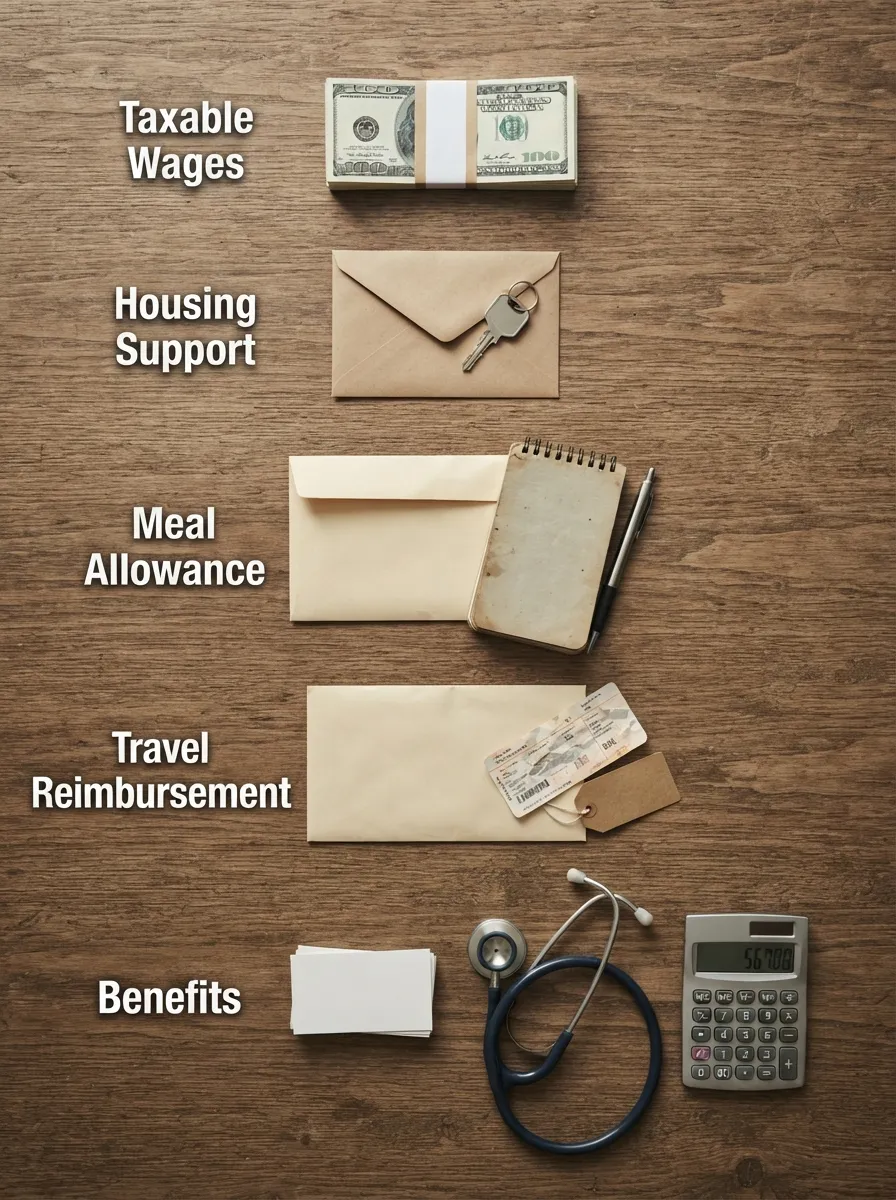
A travel nurse’s quoted weekly rate may include several separate components:
- Taxable hourly wages
- Housing stipend
- Meals and incidental expense stipend
- Overtime rate
- Completion or extension bonuses
- Travel reimbursement
- Licensing reimbursement
- Health and retirement benefits
A job advertised at $2,400 per week might not provide a $2,400 taxable paycheck.
For example, a hypothetical contract could include:
| Pay Component | Weekly Amount |
| Taxable wages | $1,150 |
| Housing stipend | $900 |
| Meals and incidentals | $350 |
| Total advertised package | $2,400 |
The taxable portion is generally subject to payroll and income taxes. Eligible reimbursements or stipends may receive different tax treatment when the nurse is genuinely traveling away from an established tax home and meets the relevant rules.
The word eligible is doing heavy lifting here. A tax-free stipend is not automatically tax-free merely because an agency labels it that way.
What Is a Travel Nurse Tax Home?

The Internal Revenue Service generally defines a tax home by the location of a person’s main place of business or employment, regardless of where the person maintains a family residence.
When a worker temporarily travels away from a tax home for business, qualifying travel expenses may be deductible or reimbursable under applicable rules. Expenses tied to an indefinite assignment generally do not qualify in the same way. The IRS treats an assignment expected to last more than one year as indefinite.
A travel nurse may need to demonstrate that they:
- Maintain a permanent residence
- Incur duplicated living expenses
- Conduct business in the tax-home area
- Return to that area periodically
- Do not abandon the original home
- Work temporary rather than indefinite assignments
A nurse who gives up a permanent residence and moves continuously from contract to contract may be considered itinerant. In that case, the assignment location can effectively become the tax home, potentially making stipends taxable.
TAX WARNING
Do not rely entirely on a recruiter’s explanation of tax-home rules. Recruiters arrange contracts; they do not represent the IRS or assume responsibility for your tax return. Consult a qualified tax professional familiar with temporary healthcare assignments.
How Much Do Travel Nurses Make Per Hour?
Travel nurse hourly rates can be misleading because the taxable hourly wage may represent only part of the compensation package.
Dividing a $2,178 weekly package by 36 hours produces an effective gross package rate of approximately $60.50 per hour. Dividing it by 40 hours produces about $54.45 per hour.
That does not mean the nurse’s taxable wage is $54 to $61 per hour. The contract might list a lower taxable base rate and provide the rest through stipends or reimbursements.
| Weekly Package | Hours Worked | Effective Package Rate |
| $2,178 | 36 hours | $60.50 per hour |
| $2,178 | 40 hours | $54.45 per hour |
| $2,500 | 36 hours | $69.44 per hour |
| $3,000 | 36 hours | $83.33 per hour |
Always compare the complete package rather than only the taxable hourly number.
How Much Does a 13-Week Travel Nurse Contract Pay?

At the July 2026 average of $2,178 per week, a 13-week assignment would gross approximately $28,314.
Here is how different weekly rates translate into a standard 13-week contract:
| Weekly Package | 13-Week Gross |
| $1,800 | $23,400 |
| $2,000 | $26,000 |
| $2,178 | $28,314 |
| $2,500 | $32,500 |
| $3,000 | $39,000 |
| $3,500 | $45,500 |
The contract’s true value depends on expenses.
A nurse earning $3,000 weekly in a city where temporary housing costs $3,800 per month may keep less than a nurse earning $2,400 in an affordable area with housing under $1,500.
How Much Do Travel Nurses Make After Taxes?

There is no universal take-home percentage. The result depends on:
- Taxable wage
- Stipend eligibility
- Filing status
- State income taxes
- Local taxes
- Payroll deductions
- Insurance premiums
- Retirement contributions
- Overtime
- Tax-home status
Consider a hypothetical $2,400 weekly package containing $1,200 in taxable wages and $1,200 in eligible stipends.
If payroll deductions and taxes reduce the taxable portion by 25%, the nurse might receive:
- $900 from taxable wages after deductions
- $1,200 in qualifying stipends
- Approximately $2,100 total weekly cash received
But that is not spendable profit. Housing, utilities, travel and duplicated home expenses still need to be paid.
A traveler who spends $700 weekly on temporary housing and related costs may have approximately $1,400 left before food, home expenses, insurance and personal spending.
Travel Nurse Pay by State

Current advertised compensation varies significantly by state.
| State or Market | Approximate Weekly Pay | Comparison |
| California | $2,590 | About 16% above national average |
| New Jersey | $2,425 | About 10% above national average |
| District of Columbia | $2,167 | Near national average |
| Virginia | $2,176 | Near national average |
| Florida | $2,096 | Slightly below national average |
| Texas | $1,844 | About 18% below national average |
These figures reflect recent marketplace postings rather than guaranteed contract rates. They can change weekly as staffing needs shift.
California frequently offers higher gross pay, but its housing, fuel, food and state taxes can consume much of the difference.
Texas contracts may advertise lower weekly packages, yet a nurse who secures inexpensive housing could keep more money than expected.
The correct question is not merely, “Which state pays the most?” It is, “Which contract leaves the most after every unavoidable cost?”
Which Travel Nursing Specialties Pay the Most?

High-paying travel assignments commonly appear in specialties where hospitals need experienced clinicians who can function quickly with limited orientation.
These may include:
- Intensive care unit nursing
- Emergency department nursing
- Operating room nursing
- Labor and delivery
- Neonatal intensive care
- Pediatric intensive care
- Cardiac catheterization
- Cardiovascular operating room
- Interventional radiology
- Dialysis
- Oncology
- Case management
Rates rise and fall according to local need. A less glamorous medical-surgical assignment can occasionally pay more than a traditionally high-paying specialty when a hospital faces a severe shortage.
Specialty alone does not determine compensation. Higher rates commonly require:
- Two or more years of recent specialty experience
- Certifications such as ACLS, PALS or specialty credentials
- Experience with the facility’s electronic medical record
- Charge nurse capability
- Flexibility for nights and weekends
- Quick start dates
- Active state licensure
Do Night-Shift Travel Nurses Make More?

Night, weekend and rotating shifts frequently carry higher rates or differential pay because they are harder to fill.
Before accepting an assignment, ask:
- Is the quoted rate for days or nights?
- Is the differential included in the weekly estimate?
- Does weekend work pay extra?
- How many weekends are required?
- Is on-call time paid?
- What is the call-back rate?
- Does overtime begin after 36 or 40 hours?
- Is overtime based on the taxable rate or a separate figure?
A high weekly package may require three 12-hour night shifts plus frequent weekends and call. Another job with slightly lower pay could deliver a far healthier schedule.
What Are Guaranteed Hours?
Guaranteed hours determine whether the hospital must pay the nurse when it cancels a scheduled shift.
A contract offering 36 guaranteed hours protects the nurse more than one allowing the facility to cancel several shifts without pay.
Review clauses covering:
- Facility-cancelled shifts
- Low census
- Orientation hours
- Sick time
- Holiday requirements
- Contract cancellation
- Missed shifts
- Make-up shifts
A $2,600 weekly offer with weak guarantees can be less valuable than a $2,300 contract that reliably pays every scheduled week.
Do Travel Nurses Get Free Housing?
Usually, travel nurses choose between:
- Agency-arranged housing
- A housing stipend
Agency housing can simplify relocation, deposits and utility setup. However, it may reduce the cash included in the weekly package and give the nurse less control over location.
Taking the stipend may be more profitable when the nurse finds inexpensive accommodation, but it also transfers the risk of deposits, cancellations, furniture, utilities and unsuitable housing to the traveler.
Before choosing a stipend, research:
- Furnished monthly rent
- Parking
- Utilities
- Internet
- Laundry
- Commute time
- Neighborhood safety
- Pet fees
- Deposits
- Early-termination policies
Never sign an expensive lease until the facility confirms the assignment and the contract’s cancellation provisions are understood.
Hidden Costs That Reduce Travel Nurse Earnings

The weekly headline number can sparkle while the costs quietly nibble at its ankles.
Common expenses include:
- Duplicated housing
- Security deposits
- Furniture or household supplies
- Rental cars
- Fuel and tolls
- Flights
- State licenses
- Certification renewals
- Medical testing
- Uniforms
- Health insurance
- Unpaid time off
- Pet transportation and boarding
- Tax preparation
- Meals during relocation
- Temporary storage
- Contract cancellation losses
A realistic comparison spreadsheet should calculate both gross compensation and projected net value.
| Contract Factor | Offer A | Offer B |
| Weekly package | $2,700 | $2,350 |
| Weekly housing cost | $1,050 | $500 |
| Weekly transport cost | $150 | $75 |
| Remaining before tax/home costs | $1,500 | $1,775 |
Offer B pays $350 less on paper but leaves $275 more after local housing and transportation.
Can Travel Nurses Earn $3,000 or More Per Week?
Yes, but $3,000 is above the current national average rather than the ordinary baseline.
Higher-paying contracts may involve:
- Expensive metropolitan markets
- Urgent starts
- Specialized critical-care experience
- Night shifts
- Crisis staffing
- Seasonal demand
- Difficult schedules
- Rural or hard-to-recruit locations
- Minimal orientation
- High housing costs
Vivian has previously reported individual travel RN postings above $5,000 weekly, but these top-end jobs are not representative of the market and may involve unusual specialties or requirements.
Treat extraordinary offers carefully. Confirm whether the rate is:
- Guaranteed for the entire contract
- Based on overtime
- Limited to one or two weeks
- Conditional on perfect attendance
- Reduced after an initial period
- Quoted before housing is removed
- Available only to a highly specific specialty
Can Travel Nurses Make $200,000 a Year?
It is possible, but not typical in the 2026 market.
To gross $200,000 over 48 working weeks, a nurse would need to average about $4,167 per week. To reach the same amount over 39 working weeks, equivalent to three 13-week contracts, the average would need to exceed $5,128 per week.
That level may be achievable through a combination of:
- Exceptionally high-paying specialties
- Overtime
- Crisis assignments
- Minimal time off
- Strong housing discipline
- Bonuses
- Local per diem work between contracts
It can also produce burnout. A high income achieved through nonstop nights, repeated relocations and six-day workweeks may be financially impressive but personally expensive.
Local Travel Nursing Versus Long-Distance Assignments
A local travel nurse accepts temporary contracts within commuting distance of home. These arrangements may offer higher hourly pay than permanent staff roles without the expense of maintaining two residences.
However, local travelers generally should not expect tax-free housing and meal stipends merely because the agency classifies the role as “travel.” Tax treatment depends on the worker’s actual circumstances and tax home, not the marketing label.
Local contracts may be attractive because they offer:
- No relocation expense
- No second rent
- Familiar state licensing
- Easier family life
- Less unpaid time between contracts
- Access to home-based benefits
Long-distance assignments provide greater destination flexibility but create higher financial and logistical risk.
Can Travel Nursing Pay for a Travel Lifestyle?
Travel nursing can fund meaningful personal travel when contracts are selected carefully and vacation periods are built into the year.
A nurse who completes three well-managed 13-week assignments has 13 remaining weeks in the year, although unpaid time reduces annual income.
That flexibility can make ambitious trips possible. Someone ending an assignment near a major international airport might use a break to explore the Maldives, for example. TravelBlogSpace’s Malé city tour review explains what a short capital visit can look like, while its Maldives snorkeling experience covers a very different ocean-centered day.
The key is separating work compensation from vacation fantasy. Do not count a housing stipend as travel money until temporary rent, permanent-home costs and taxes have been covered.
How to Compare Two Travel Nurse Contracts

Ask each recruiter for a written pay breakdown containing:
- Taxable hourly rate
- Regular weekly hours
- Housing stipend
- Meals and incidental stipend
- Overtime rate
- Holiday rate
- On-call pay
- Guaranteed hours
- Travel reimbursement
- Completion bonus
- Insurance cost
- Retirement benefits
- Licensing reimbursement
- Cancellation policy
Then calculate:
Total contract pay − taxes − temporary housing − duplicated home costs − transportation − insurance − licensing = estimated contract value
Do not compare one recruiter’s gross package with another recruiter’s after-tax estimate. Put every offer into the same format.
CONTRACT TIP
Ask recruiters to show the math behind the weekly figure. A round number without a taxable-rate and stipend breakdown is decoration, not analysis.
How to Increase Travel Nurse Earnings
Build experience before traveling
Most hospitals expect travelers to begin working with minimal orientation. Two years of recent specialty experience is a common practical benchmark, although requirements differ.
Maintain in-demand certifications
Current ACLS, PALS, NIHSS or specialty credentials can widen assignment choices.
Use a compact nursing license
Nurses whose primary state of residence participates in the Nurse Licensure Compact may qualify for multistate practice privileges, subject to the compact’s rules. License status and participating states should be checked through the relevant nursing boards before accepting an assignment.
Remain flexible about location
The highest-paying job may be outside famous destinations. Flexibility can create more bargaining power than chasing only California beaches or Manhattan hospitals.
Negotiate the complete package
Possible negotiation points include:
- Travel reimbursement
- Licensing costs
- Guaranteed hours
- Start date
- Completion bonus
- Shift differential
- Time off
- Housing allowance
Control housing costs
Housing is often the largest variable expense. A modest furnished apartment near work may produce more savings than a luxury building paired with an impressive weekly rate.
Avoid long unpaid gaps
Time off has value, but it should be planned. Two unplanned months between contracts can erase the advantage of a strong weekly package.
Travel Nursing and Personal Adventure
One appeal of travel nursing is the ability to arrange life in chapters: work intensely, save deliberately and then take a real break.
A nurse planning a Maldives vacation could choose experiences ranging from a drone and underwater photoshoot to a beach horseback adventure. Travelers trying to fit several activities into a short stay can also compare this full Maldives adventure with booking separate excursions.
Yet the wisest first “destination” for surplus travel-nurse income may be less photogenic:
- Emergency savings
- Retirement contributions
- Health-insurance reserves
- Tax payments
- A contract-cancellation fund
- Licensing expenses
- Debt repayment
Once those foundations are secure, the passport can have its turn.
Travel Nurse Contract Checklist
- Confirm the taxable hourly rate
- Request a full stipend breakdown
- Verify guaranteed hours
- Read the cancellation clause
- Confirm overtime calculations
- Check weekend and holiday requirements
- Calculate local housing costs
- Estimate transport and parking
- Review health-insurance dates
- Confirm licensing reimbursement
- Research the facility and unit
- Ask about nurse-to-patient ratios
- Verify floating requirements
- Confirm requested time off in writing
- Discuss tax-home status with a professional
- Keep records of duplicated expenses
- Build an emergency fund before relocating
- Avoid signing housing too early
Frequently Asked Questions About Travel Nurse Pay
How much do travel nurses make per week?
Travel registered nurse assignments averaged about $2,178 per week nationwide in July 2026, based on current job postings.
How much do travel nurses make per year?
At the current average, 48 working weeks would annualize to approximately $104,544, while 52 weeks would equal about $113,256. Actual earnings often differ because of unpaid gaps and expenses.
How much does a 13-week contract pay?
A 13-week contract at $2,178 weekly would gross approximately $28,314.
Do travel nurses make more than staff nurses?
They sometimes do, particularly in high-demand specialties or locations. However, the current nationwide travel premium is less dramatic than during the pandemic, and travelers often pay duplicated housing and relocation costs.
What state pays travel nurses the most?
California frequently offers high gross rates and currently averages around $2,590 per week on Vivian. Its cost of living can substantially reduce the advantage.
Are travel nurse housing stipends tax-free?
They may qualify for favorable tax treatment when the nurse maintains a legitimate tax home and is temporarily working away from it. The label “stipend” alone does not determine tax status.
Do travel nurses get free housing?
Some agencies arrange housing, while others provide a stipend. Agency housing is not necessarily free because its cost may be reflected in a lower compensation package.
Can new graduates become travel nurses?
Most facilities want travelers who can work independently with limited orientation. New graduates generally benefit from gaining solid staff experience before traveling.
How long are travel nurse contracts?
Thirteen weeks is common, but assignments can be shorter or longer depending on facility needs.
Do travel nurses receive benefits?
Many agencies offer health insurance, retirement programs and other benefits. Coverage, eligibility periods and costs vary significantly.
Can travel nurses make $3,000 per week?
Yes, although that is above the current national average. Specialty, location, urgency and shift requirements influence access to higher rates.
Can travel nurses earn $200,000?
Some can through high-paying contracts and overtime, but $200,000 is not typical. It would require average weekly compensation well above the current market rate.
Do travel nurses pay for two homes?
Travelers seeking qualifying tax-free reimbursements commonly maintain a permanent tax home while also paying for temporary lodging near the assignment.
What happens when a hospital cancels a contract?
Compensation may stop immediately, and the nurse can remain responsible for temporary housing. Cancellation terms and emergency savings are therefore essential.
Is travel nursing still worth it in 2026?
It can be worthwhile for experienced nurses who value flexibility, compare total contract economics and control housing expenses. It is less attractive when relocation costs consume the pay premium.
Conclusion: How Much Do Travel Nurses Really Make?
In 2026, the clearest national benchmark is approximately $2,178 per week, equivalent to about $28,314 for a 13-week assignment. A traveler working 48 weeks at that rate would gross around $104,544, while a continuous 52-week schedule would annualize to approximately $113,256.
Those numbers answer only the first layer of the question.
A travel nurse’s real income depends on taxable wages, stipend eligibility, housing costs, insurance, relocation expenses, guaranteed hours and time between assignments. A $3,000 weekly contract in an expensive city may produce less usable income than a $2,300 assignment with affordable housing and dependable scheduling.
The strongest travel nurses therefore evaluate contracts like small businesses. They compare net value rather than headline pay, protect themselves against cancellation, maintain accurate tax records and negotiate the details that recruiters sometimes leave in the fog.
Travel nursing can still provide competitive earnings, geographic freedom and extended breaks for personal travel. But the profession is not a paid vacation with occasional hospital shifts. It demands experience, adaptability and financial discipline.
The weekly number may open the door. What remains after housing, taxes and twelve demanding hours on the unit is the figure that truly matters.
