Algarve Hidden Gems: 15 Beautiful Places Most Tourists Miss
The Algarve is famous for its golden cliffs, dramatic beaches, turquoise water and resort towns.
But there is another Algarve hiding behind the postcards.
Drive inland and the beach crowds begin to disappear. Follow a winding road into the hills and you’ll find whitewashed villages, old watermills, cork forests and viewpoints stretching across the countryside. Head toward the eastern Algarve and the landscape changes again, with quiet fishing communities, salt marshes and islands scattered across the Ria Formosa.
These are the places that make you realize the Algarve is much more than a beach destination.
If you’re looking for Algarve hidden gems, these 15 places are worth putting on your itinerary.
Some are genuinely peaceful villages. Others are lesser-known beaches, natural areas or viewpoints that deserve far more attention.
And the best part?
You don’t have to give up the famous Algarve entirely. You can enjoy the major sights and then escape to these quieter corners when you need a break from the crowds.
Recommended Travel Items for Your Trip
1. Alte

If you want to see a more traditional side of the Algarve, Alte should be high on your list.
This beautiful inland village feels worlds away from the busy resort strip.
Whitewashed houses, colorful trim, traditional chimneys and narrow streets give the historic center plenty of character. Alte is also surrounded by springs, streams and small waterfalls, making it especially appealing during the warmer months.
Visit Fonte Grande and Fonte Pequena, then wander through the village before finding somewhere local for lunch.
The nearby Queda do Vigário waterfall adds another reason to explore beyond the historic center.
Portugal’s official tourism site describes Alte as one of the Algarve’s most authentic villages, and it’s easy to understand why once you arrive.
Why visit Alte?
- Traditional Algarve architecture
- Historic village streets
- Natural springs
- Queda do Vigário waterfall
- Quiet inland atmosphere
- Great starting point for exploring rural Algarve
Best for: Villages, photography, slow travel and escaping the coast.
2. Cacela Velha

Cacela Velha may be small, but its setting is enormous.
This tiny historic village overlooks the Ria Formosa, with a fortress, whitewashed houses and sweeping views across the lagoon and barrier islands.
It’s the sort of place where you don’t need a packed sightseeing schedule.
Walk through the village.
Visit the fortress.
Find a viewpoint.
Then simply sit down and enjoy the landscape.
The settlement has a long history, including Moorish-era occupation, and the present fortress dates from the reigns of Portuguese kings John III and Sebastian.
From the viewpoint, you can see the intricate landscape of lagoon, sandbanks, islands and sea.
Don’t miss
The view from the fortress is the main event.
If conditions and local services allow, you can also reach nearby island beaches from the Fábrica area by small boat.
Cacela Velha is particularly beautiful around golden hour.
Best for: History, photography, peaceful views and romantic escapes.
3. Monchique

Most visitors associate the Algarve with beaches.
Monchique reminds you that there are mountains here too.
Tucked into the Serra de Monchique, this hill town has steep streets, traditional houses and lush surroundings.
The atmosphere is completely different from the coastal resorts.
Wander through the old streets, stop at a café and enjoy the views between the buildings.
Portugal’s tourism authority specifically recommends exploring Monchique on foot because its steep streets reveal different perspectives of the surrounding hills.
For bigger views, continue into the mountains toward Fóia, the highest point in the Algarve.
Why Monchique feels different
- Mountain scenery
- Traditional architecture
- Cooler, greener surroundings
- Hiking opportunities
- Local food and crafts
- Panoramic viewpoints
This is one of the best places to experience the Algarve away from the sea.
Best for: Hiking, mountain scenery and rural Portugal.
4. Fonte Benémola

For a quieter nature escape, head to the Protected Landscape of Fonte Benémola.
This green pocket of the Algarve is centered around a river and surrounded by countryside, making it a refreshing change from the exposed coastal landscapes.
It’s particularly appealing to hikers and travelers who want to see the region’s inland side.
The area has been highlighted by Portugal’s tourism authority among the Algarve’s lesser-known natural landscapes.
What to expect
- Walking trails
- Riverside scenery
- Green vegetation
- Rural landscapes
- Water features
- Peaceful surroundings
Don’t arrive expecting a major tourist attraction with rows of shops and restaurants.
That’s precisely the point.
Best for: Nature walks, photography and peaceful afternoons.
5. Salir

Salir is another inland village that deserves more attention.
It sits in the hills north of Loulé and makes an excellent stop if you’re exploring the rural Algarve.
The village is surrounded by countryside and traditional landscapes, while the remains of its old castle provide a glimpse into the area’s medieval past.
Salir can easily be combined with Alte and Querença for an inland Algarve road trip.
The three villages form part of the Algarvensis Geopark and are highlighted by Portugal’s tourism authority as worthwhile destinations for discovering the region’s rural interior.
Best for: Road trips, villages and exploring the Algarve’s interior.
6. Querença

If your ideal Portuguese afternoon involves a tiny village, a beautiful church, quiet streets and a long lunch, Querença may be exactly what you’re looking for.
The village sits among the hills of the Algarve’s interior and retains a traditional character that feels far removed from the larger coastal resorts.
It’s another excellent stop on an inland road trip.
Pair it with Alte and Salir and you have a full day exploring a side of the Algarve that many beach-focused itineraries completely overlook.
Best for: Slow travel, traditional villages and countryside drives.
7. Praia da Amoreira

The western Algarve is where things start to feel considerably wilder.
Praia da Amoreira, near Aljezur, is a particularly beautiful example.
Here, the Amoreira River meets the Atlantic, creating a striking landscape of sand, water and rugged cliffs.
It’s very different from the resort beaches farther east.
The official Algarve tourism material describes this western coastline as less explored, with beaches such as Amoreira, Monte Clérigo, Arrifana and Carrapateira tucked beneath dramatic cliffs.
Why visit?
The combination of river and ocean is the real attraction.
You can enjoy the beach while also exploring the surrounding coastal scenery.
Best for: Nature, surfing, photography and wild coastal landscapes.
8. Monte Clérigo

Another western Algarve favorite, Monte Clérigo has the rugged beauty that makes this stretch of coastline so appealing.
Instead of manicured resort scenery, you’ll find cliffs, open landscapes and Atlantic waves.
It’s near Aljezur and works well as part of a day exploring the Costa Vicentina.
Make a day of it
Combine Monte Clérigo with:
- Aljezur
- Praia da Amoreira
- Arrifana
- Carrapateira
- Bordeira
The western coast is especially good for travelers who prefer dramatic landscapes to resort-style beaches.
Best for: Surfers, road trippers and adventurous beach lovers.
9. Carrapateira
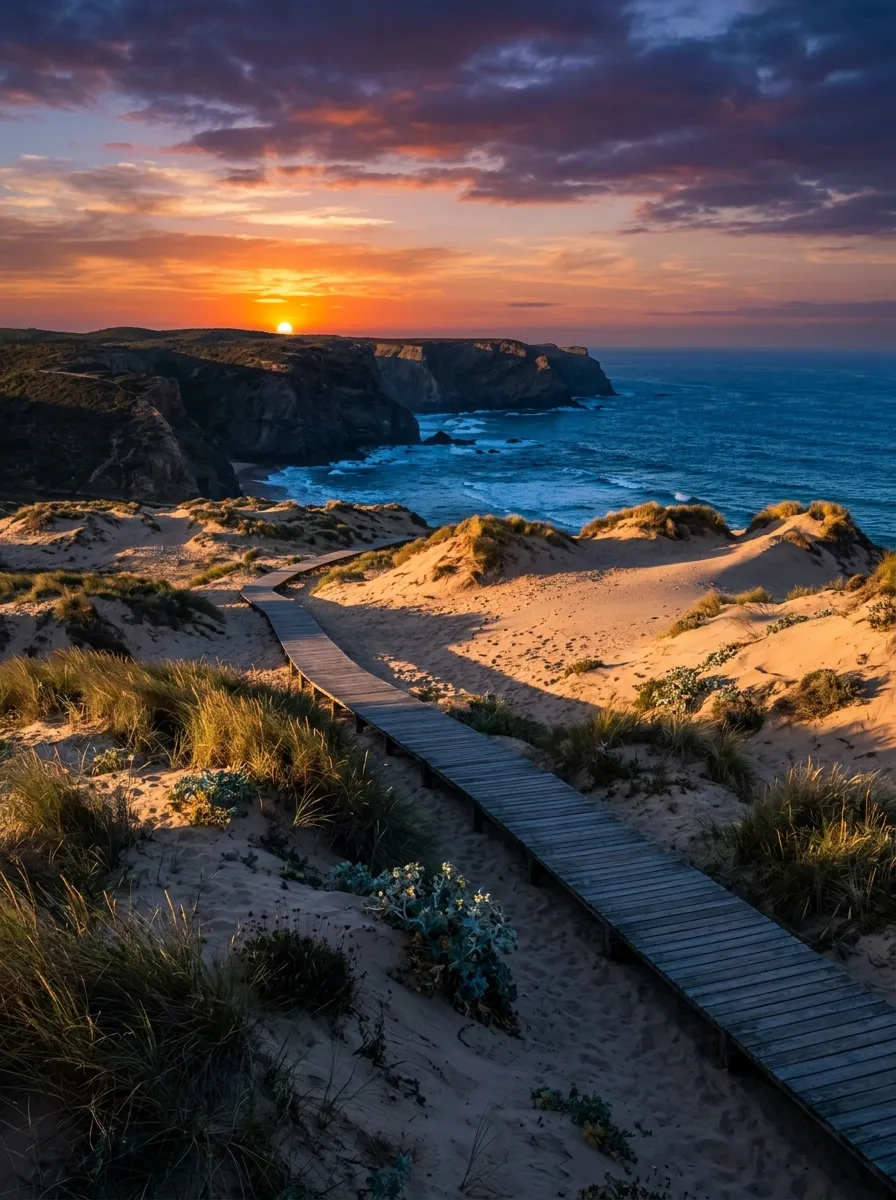
Carrapateira is one of those places where the landscape does most of the talking.
Located on the western coast, it’s surrounded by dunes, cliffs and enormous Atlantic views.
Nearby Praia da Bordeira is particularly spectacular.
This isn’t the Algarve for travelers looking for beach clubs and nightlife.
It’s the Algarve for long walks, surfboards, windblown hair and dramatic sunsets.
Things to do
- Explore Praia da Bordeira
- Walk the coastal trails
- Watch surfers
- Explore the village
- Photograph the cliffs and dunes
- Watch sunset
Best for: Surfing, hiking, photography and wild beaches.
10. Fóia

If you’re already visiting Monchique, continue uphill.
Fóia is the highest point in the Algarve and offers enormous views across the surrounding landscape.
On clear days, the panorama can stretch toward the coast and across the rolling hills.
The drive itself is part of the experience.
Bring a jacket even during warmer months because mountain weather can be noticeably different from the coast.
Fóia is also connected with the Via Algarviana, a long-distance trail crossing the Algarve from Alcoutim toward Cape St. Vincent.
Best for: Panoramic views, road trips and hiking.
11. Fuseta

The eastern Algarve has a completely different personality.
Fuseta is a small fishing town on the edge of the Ria Formosa, with a relaxed atmosphere and access to beautiful coastal scenery.
This is the kind of place where you can slow down.
Watch fishing boats.
Walk along the waterfront.
Eat seafood.
Then take a boat toward the islands and beaches.
For a panoramic perspective, the Torre da Fuseta offers views across the Ria Formosa and its sandy islands.
Best things to do
- Explore the waterfront
- Eat fresh seafood
- Visit the beach
- Take a boat trip
- Explore Ria Formosa
- Climb to the Torre da Fuseta viewpoint
Best for: Seafood, fishing culture and quieter coastal travel.
12. Ria Formosa’s Quieter Corners

The Ria Formosa Natural Park is not exactly a secret.
But many visitors don’t explore enough of it.
This enormous wetland system stretches along roughly 60 kilometers of the Algarve coast and contains canals, marshes, barrier islands and sandy beaches.
It’s one of the region’s most important wildlife areas.
Instead of simply visiting a beach, spend time exploring the lagoon itself.
Look for
- Wading birds
- Salt pans
- Fishing boats
- Shellfish beds
- Lagoon channels
- Barrier islands
Walking trails and traditional boat trips are among the best ways to experience the landscape.
Best for: Birdwatching, nature, photography and slow travel.
13. Castro Marim Salt Marshes

Near the Spanish border, Castro Marim offers one of the Algarve’s most unusual landscapes.
Instead of golden beaches, you’ll find salt pans, wetlands, farmland and the Guadiana River.
The Castro Marim and Vila Real de Santo António Marshlands are a protected natural area and an excellent place to explore on foot or by boat.
Birdlife is one of the biggest attractions.
Bring binoculars if you’re interested in wildlife.
Why go?
Because it shows you another Algarve.
One built around wetlands, salt production, agriculture and the river rather than beach resorts.
Best for: Birdwatching, nature lovers and photographers.
14. Aljezur

Aljezur is one of the best bases for discovering the western Algarve.
The town sits beneath the remains of a historic castle and is surrounded by rolling countryside.
It’s also close to some of the region’s best wild beaches.
The castle provides a particularly good viewpoint over the whitewashed town and surrounding landscape.
Use Aljezur as a base for
- Praia da Amoreira
- Monte Clérigo
- Arrifana
- Carrapateira
- Bordeira
- Costa Vicentina hiking trails
It’s a particularly good choice if you want an Algarve road trip with a more adventurous feel.
Best for: Road trips, hiking, beaches and history.
15. Barão de São João

Near Lagos, Barão de São João is an easy place to overlook if you’re focused on the Algarve’s beaches.
That’s exactly why it belongs on this list.
This small inland village sits among countryside and cork and pine landscapes, offering a quieter alternative to the busy coastal towns.
The village is also connected with walking routes through the surrounding landscape and the wider Via Algarviana network.
Spend some time wandering around, then explore the countryside beyond the village.
It’s a reminder that even close to famous destinations like Lagos, you can find a completely different pace of life.
Best for: Village walks, countryside and travelers seeking something different.
Algarve Hidden Gems Map: How to Group Them
The Algarve is much easier to explore when you stop thinking about it as one giant destination.
Instead, divide your hidden gems into regions.
| Area | Hidden Gems |
| Inland Algarve | Alte, Salir, Querença |
| Serra de Monchique | Monchique, Fóia |
| Central Nature | Fonte Benémola |
| Western Algarve | Aljezur, Amoreira, Monte Clérigo, Carrapateira |
| Eastern Algarve | Fuseta, Cacela Velha |
| Ria Formosa | Ria Formosa islands and wetlands |
| Far East | Castro Marim |
| Near Lagos | Barão de São João |
This makes it much easier to build day trips without spending half the day driving back and forth.
Best Algarve Hidden Gems for Different Travelers
Not every hidden gem is going to appeal to every traveler.
Here’s the quick version.
| If You Want… | Go Here |
| A traditional village | Alte |
| Mountain scenery | Monchique |
| The highest viewpoint | Fóia |
| A peaceful nature walk | Fonte Benémola |
| A historic village with incredible views | Cacela Velha |
| Wild beaches | Amoreira |
| Surfing | Carrapateira |
| Dramatic coastline | Monte Clérigo |
| Fishing culture | Fuseta |
| Birdwatching | Ria Formosa |
| Salt marshes | Castro Marim |
| A western Algarve base | Aljezur |
| Quiet countryside | Barão de São João |
How to Find the Algarve’s Hidden Gems
You don’t necessarily need a secret local contact or a dusty treasure map.
You just need to travel slightly differently.
Go inland
The biggest concentration of Algarve tourism is along the coast.
Move inland and the atmosphere changes quickly.
Villages such as Alte, Salir and Querença provide a glimpse into a more traditional rural Algarve.
Visit outside peak summer
July and August can bring substantial crowds to the most popular coastal areas.
Spring and autumn can offer a more comfortable balance of weather and fewer people.
Start early
Even popular places feel remarkably peaceful early in the morning.
This is especially useful for viewpoints and beaches.
Rent a car
A car gives you much more freedom to explore the inland villages and western coastline.
Public transportation can work for major towns, but some of the most interesting places are much easier to reach independently.
Don’t chase Instagram spots
A location being famous online doesn’t automatically make it a better travel experience.
Sometimes the most memorable stop is the tiny village café you discovered because you missed a turn.
Best Time to Explore Algarve Hidden Gems
The Algarve has a mild climate and is popular throughout much of the year, but different seasons offer different experiences.
Spring
March to May
Excellent for:
- Hiking
- Wildflowers
- Villages
- Road trips
- Comfortable temperatures
Summer
June to August
Best for:
- Swimming
- Beaches
- Long evenings
- Coastal activities
But expect more visitors, particularly around major resort areas.
If you’re planning an August trip, our guide to the best places to travel in August has more ideas for late-summer adventures.
Autumn
September to November
One of the most appealing periods for exploring.
The sea can remain warm into early autumn, while the intense summer heat begins to ease.
Winter
December to February
The Algarve is considerably quieter.
It isn’t classic beach weather every day, but it’s a great period for:
- Villages
- Hiking
- Road trips
- Photography
- Slow travel
If you’re looking for winter travel inspiration beyond Portugal, our December travel guide covers destinations around the world.
How Many Days Do You Need for Algarve Hidden Gems?
You can see a few hidden gems on a weekend, but 5–7 days gives you enough time to explore without turning the trip into a driving marathon.
3 days
Focus on one area.
For example:
Day 1: Alte + Fonte Benémola
Day 2: Monchique + Fóia
Day 3: Aljezur + Amoreira
5 days
Add the eastern Algarve:
Day 1: Alte + Salir
Day 2: Monchique + Fóia
Day 3: Aljezur + western coast
Day 4: Fuseta + Ria Formosa
Day 5: Cacela Velha + Castro Marim
7 days
Slow down.
Give yourself extra time around the western coast and Ria Formosa rather than simply adding more locations.
That’s the trick to discovering hidden gems.
Don’t turn them into a checklist.
A Perfect Algarve Hidden Gems Road Trip
If you have a rental car and about a week, this route works beautifully:
Faro → Alte → Salir → Querença → Monchique → Fóia → Aljezur → Amoreira → Monte Clérigo → Carrapateira → Fuseta → Cacela Velha → Castro Marim
You don’t necessarily need to visit every stop.
Think of this as a framework rather than a race.
For a broader look at Portugal’s destinations, you can also explore our guide to the best cities to travel in Portugal.
What to Eat While Exploring the Algarve
Hidden-gem hunting works up an appetite.
And fortunately, the Algarve has plenty to offer beyond the tourist menus.
Look for regional dishes featuring:
- Fresh grilled fish
- Sardines
- Clams
- Oysters
- Mussels
- Razor clams
- Cataplana
- Octopus
- Almonds
- Figs
- Carob
The eastern Algarve and Ria Formosa are particularly associated with seafood and shellfish.
Traditional food is part of the reason slowing down matters.
A long lunch in a small village can be more memorable than another hour squeezing through a crowded attraction.
Algarve Hidden Gems Travel Tips
Wear proper shoes
Some coastal paths and inland trails can be uneven.
Flip-flops are wonderful inventions.
They are less wonderful when you’re walking over rocks.
Bring water
Especially when hiking or exploring exposed coastal areas during warmer months.
Check beach conditions
The Atlantic can be powerful.
Follow local warnings and lifeguard instructions.
Respect protected landscapes
The Algarve contains important natural areas and wildlife habitats.
Stay on marked trails where required and don’t disturb plants or animals.
Don’t assume “hidden” means empty
Places described as hidden gems online can become popular quickly.
Go early or visit outside peak periods if solitude is your priority.
Slow down
This may be the most important tip.
The Algarve’s best moments aren’t always spectacular.
Sometimes they’re a quiet village square, a seafood lunch, a mountain road or a completely empty stretch of coastline.
Final Thoughts on Algarve Hidden Gems
The Algarve’s famous beaches deserve their reputation.
But they aren’t the whole story.
Beyond the resorts, you’ll find Alte’s traditional streets, Monchique’s green mountains, Fonte Benémola’s peaceful landscape, Aljezur’s rugged coastline, Fuseta’s fishing culture and Cacela Velha’s extraordinary views over the Ria Formosa.
The western coast feels wild.
The mountains feel rural.
The eastern Algarve feels connected to the water and fishing traditions.
And the inland villages reveal a slower Portugal that many visitors never see.
That’s what makes exploring the Algarve’s hidden gems so rewarding.
You don’t have to avoid the famous places.
Visit Lagos.
See the cliffs.
Enjoy the beaches.
Then rent a car, leave the main tourist road and follow the landscape inland.
That’s where the Algarve starts telling a different story.
And if Portugal is only one stop on a larger European adventure, you can continue exploring with our best travel destinations in August or use our Costa Rica guide when you’re ready to trade European villages for tropical wilderness: best time to travel to Costa Rica.
The Algarve may be famous.
But it still has corners that feel like you found them yourself.